Debt-to-Income Ratio for a Mortgage: How DTI Works and How to Lower It
Updated September 27, 2026 · 5 min read
Your debt-to-income ratio (DTI) is one of the two or three numbers that most shape a mortgage decision. It tells a lender how much of your income is already committed to debt — and how much room is left for a housing payment. Understanding it helps you predict what you can borrow, and what to fix before you apply.
Educational content, not lending advice. Limits vary by lender, program and your full financial profile.
What is debt-to-income ratio?
DTI = total monthly debt payments ÷ gross monthly income.
Lenders look at two versions:
- Front-end DTI (housing ratio): your proposed housing payment — principal, interest, property tax, insurance, mortgage insurance and HOA dues — divided by gross monthly income.
- Back-end DTI: housing payment plus all other monthly debt payments, divided by gross monthly income. When people say "DTI", they usually mean this one.
How to calculate it: a worked example
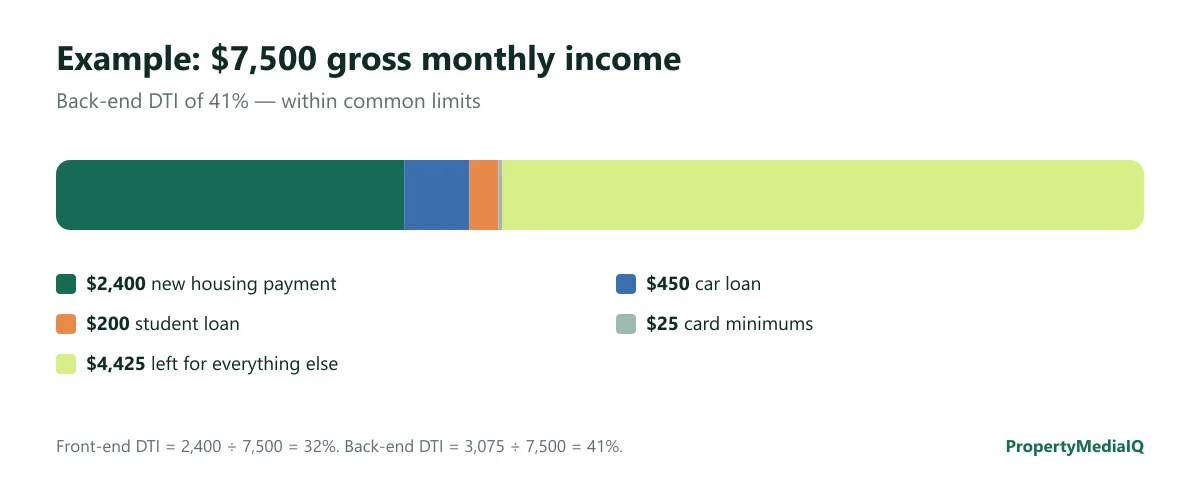
Alex earns $90,000 a year — $7,500 gross per month — and is looking at a home with a $2,400 total monthly housing payment. Other debts: a $450 car payment, a $200 student loan payment, and $25 in credit card minimums.
- Front-end DTI: $2,400 ÷ $7,500 = 32%
- Back-end DTI: ($2,400 + $450 + $200 + $25) ÷ $7,500 = $3,075 ÷ $7,500 = 41%
What DTI do lenders accept?
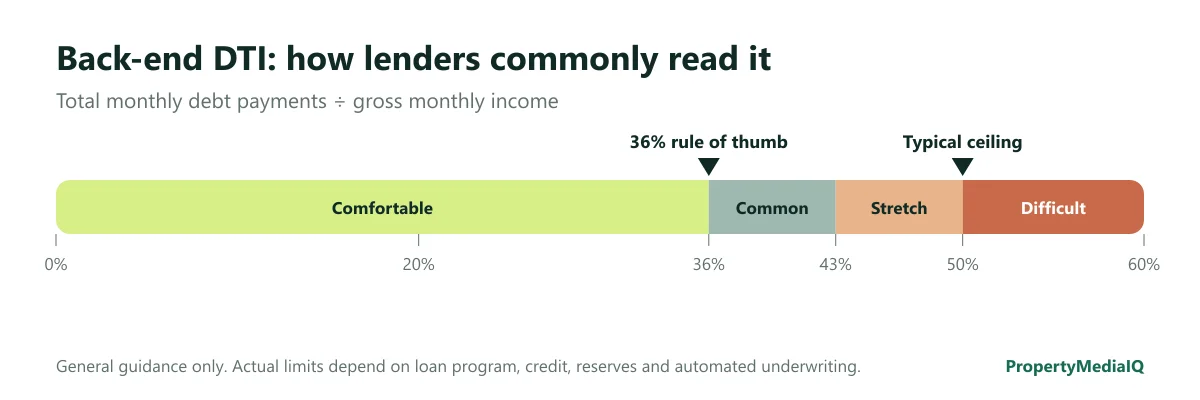
There is no single number. Limits depend on the loan program, your credit score, cash reserves, and whether the loan is approved through automated underwriting. As a general guide:
| Loan type | General back-end DTI guidance |
|---|---|
| Conventional | Often up to 45%; up to 50% with automated underwriting approval and strong compensating factors |
| FHA | Commonly 43% as a benchmark; higher ratios can be approved with compensating factors |
| VA | Uses a 41% benchmark alongside a "residual income" test; can approve higher with sufficient residual income |
| USDA | Commonly around 29% front-end / 41% back-end, with exceptions possible |
"Compensating factors" typically include a higher credit score, larger down payment, significant cash reserves, or a history of handling similar payments.
The traditional 28/36 rule — 28% housing, 36% total — is more conservative than most program limits. It's a good target for comfort, not the approval ceiling. See how much house you can afford.
Which debts count?
Usually included:
- the new mortgage payment (PITI plus HOA);
- car loans and leases;
- student loans (with specific rules for income-driven or deferred payments);
- credit card minimum payments;
- personal loans;
- child support and alimony payments;
- other mortgages, including rental properties (with rental income treated separately).
Usually not included:
- utilities, phone, internet, streaming;
- groceries, fuel, childcare;
- insurance premiums other than homeowners/mortgage insurance;
- income taxes.
Those costs still matter for your budget — they just aren't in the lender's ratio.
What counts as income?
Gross (pre-tax) income that is stable and documented: salary, hourly wages, and — with enough history — overtime, bonuses, commissions, self-employment income, rental income, alimony received, and certain benefits. Self-employed borrowers are usually assessed on net business income from tax returns, which can be much lower than revenue.
Seven ways to lower your DTI
- Pay off a small loan entirely. Eliminating a $450 car payment lowers DTI far more than paying down a large balance slightly.
- Pay down credit cards to reduce minimum payments.
- Don't take on new debt — no new car, no store financing — before or during the loan process.
- Add a co-borrower whose income is documented (their debts count too).
- Document all eligible income, such as consistent overtime or a side business with tax history.
- Choose a lower-priced home or larger down payment to reduce the housing payment.
- Consider lower-payment structures — a rate buydown, or a program with lower mortgage insurance.
DTI vs. credit score vs. down payment
Lenders weigh these together. A high credit score and large reserves can offset a higher DTI; a low score with a high DTI is hard to approve. Knowing which lever is easiest for you to move — paying off a card, waiting three months, saving more — is the key to a faster approval.
For real estate agents: talk about DTI without asking for numbers
DTI is the lender's job, but it explains many surprises: a buyer "pre-approved for $450K" who can't close after financing a new car, or a buyer whose realistic budget is far below their expectations. Agents can help without asking for sensitive information:
- ask early whether the buyer has spoken to a lender and is pre-approved — see pre-qualification vs. pre-approval;
- remind pre-approved buyers not to take on new debt until closing;
- refer buyers who haven't started financing to a lender before touring widely.
A short pre-call questionnaire captures financing status, timeline and budget range without asking for income or debt details. Buyer Intelligence turns those answers into a readiness score and a call brief, so you know which buyers need a lender introduction and which are ready to tour.
Frequently asked questions
What's a good debt-to-income ratio for a mortgage? 36% or less is comfortable; many programs approve into the 40s, and some up to 50% with strengths.
Does rent count in DTI? Your current rent doesn't, because the new mortgage payment replaces it.
Do deferred student loans count? Usually yes — lenders apply program-specific rules to estimate a payment.
Can I get a mortgage with 50% DTI? Sometimes, depending on program, credit and reserves. Talk to a lender.
The bottom line
Calculate your back-end DTI before you apply, aim for comfort near 36%, and use the fastest lever you have — usually eliminating a small monthly payment — to improve it.
Agents: see how Buyer Intelligence prepares every buyer call →
Know which buyers are ready before you call.
Share one branded link and get a readiness score, report, and call brief for every lead — from $39/month.