How Much House Can I Afford? A Realistic 2026 Guide With Examples
Updated September 27, 2026 · 7 min read
"How much house can I afford?" has two answers. The first is what a lender will approve. The second — the one that matters more — is what you can pay every month and still live the life you want. This guide covers both: how lenders calculate affordability, what a mortgage payment actually includes, realistic price ranges by income at 2026 rates, and how to set a budget you'll still be happy with in five years.
This guide is educational and not financial advice. Your lender's pre-approval is the only reliable number for your situation.
The quick answer
Most lenders start with two ratios:
- Front-end ratio (housing ratio): your total monthly housing cost — principal, interest, property tax, insurance, mortgage insurance and HOA dues — divided by your gross monthly income. A traditional guideline is 28%.
- Back-end ratio (debt-to-income, DTI): housing cost plus all other monthly debt payments, divided by gross monthly income. A traditional guideline is 36%, and many programs allow more — often up to the mid-40s, and up to 50% in some cases with strong credit or reserves.
That's the 28/36 rule. It isn't a law — it's a starting point that keeps most budgets comfortable. For how lenders treat higher ratios, see our full guide to debt-to-income ratio for a mortgage.
Home price by income: realistic estimates
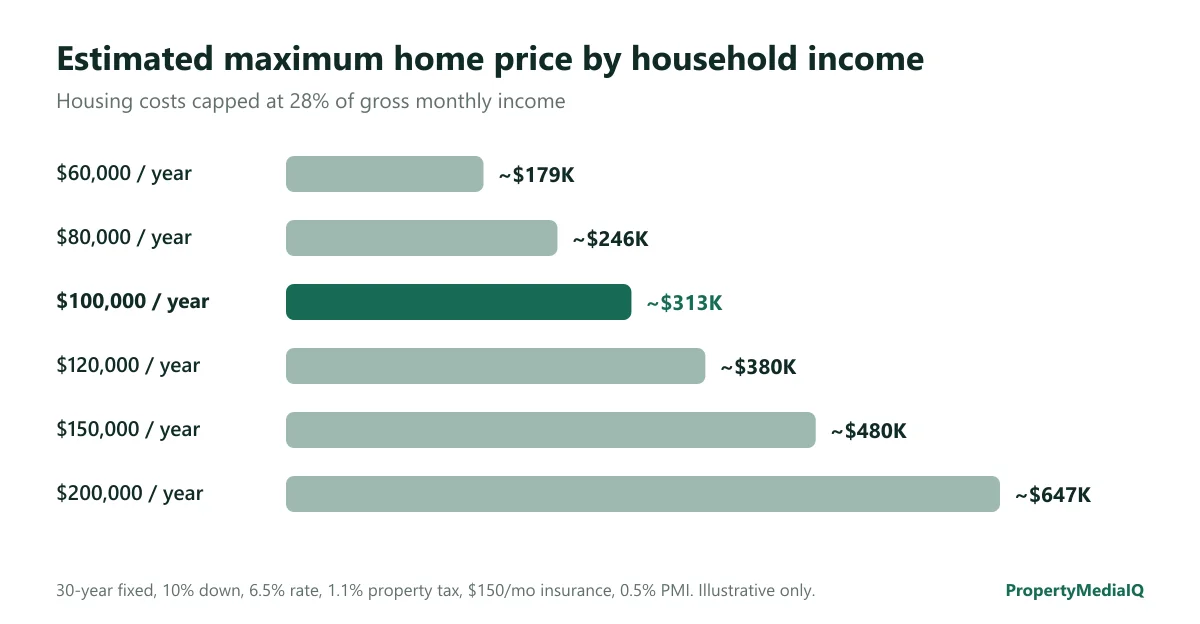
Here's what the 28% housing guideline produces at a 6.5% 30-year fixed rate, with 10% down.
| Household income | Monthly housing budget (28%) | Estimated home price | Principal & interest | Tax | Insurance | PMI |
|---|---|---|---|---|---|---|
| $60,000 | $1,400 | ~$179,000 | $1,019 | $164 | $150 | $67 |
| $80,000 | $1,867 | ~$246,000 | $1,399 | $225 | $150 | $92 |
| $100,000 | $2,333 | ~$313,000 | $1,779 | $287 | $150 | $117 |
| $120,000 | $2,800 | ~$380,000 | $2,160 | $348 | $150 | $142 |
| $150,000 | $3,500 | ~$480,000 | $2,730 | $440 | $150 | $180 |
| $200,000 | $4,667 | ~$647,000 | $3,681 | $593 | $150 | $243 |
These numbers move a lot with a few inputs:
- Rates: every half-point changes buying power by roughly 5%. See how mortgage rates affect buying power.
- Property tax: rates vary from well under 1% to over 2% of value depending on the state and county.
- HOA dues: a $300/month HOA reduces the price you can afford by tens of thousands of dollars.
- Other debts: car loans and student loans reduce the room left under the back-end ratio.
- Down payment: more down means a smaller loan, and at 20% no private mortgage insurance on a conventional loan.
What a mortgage payment really includes
Online calculators often show only principal and interest. Your real payment — often called PITI — includes more.
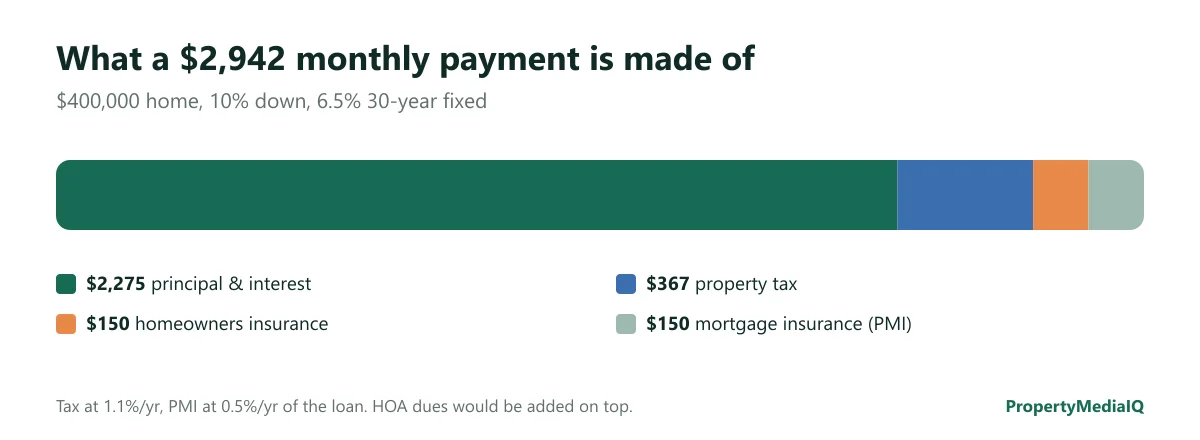
- Principal — repaying the loan.
- Interest — the cost of borrowing.
- Taxes — property tax, usually collected monthly into escrow.
- Insurance — homeowners insurance, plus flood or wind coverage where required.
- Mortgage insurance — PMI on conventional loans with less than 20% down, or MIP on FHA loans.
- HOA dues — if the property has an association.
On top of the payment, budget for maintenance (a common rule of thumb is 1% of the home's value per year, more for older homes), utilities that may be higher than in a rental, and closing costs at purchase — often a few percent of the price.
Approved vs. comfortable
Lenders approve based on ratios. They don't know that you want to travel, save for college, change careers, or keep a healthy emergency fund. That's why many buyers set their target below their approval amount.
A practical approach:
- Start from your take-home pay, not gross income.
- Subtract non-negotiables: savings goals, childcare, transport, insurance, current debts.
- Decide the monthly payment you'd be comfortable with even if your income dropped or costs rose.
- Work backwards to a price using today's rates, taxes and insurance for the areas you want.
- Compare with your pre-approval. Shop at the lower of the two numbers.
Six ways to afford more (without overextending)
- Improve your credit score before applying — it affects both approval and rate.
- Pay down small debts to lower your DTI; a paid-off car loan can add meaningful buying power.
- Look at low-down-payment programs and down payment assistance — see our down payment assistance guide.
- Compare lenders. Rate and fee differences between lenders can be significant; multiple mortgage credit checks within a short shopping window are generally treated as one inquiry by credit scoring models.
- Consider rate buydowns — temporary or permanent — especially when a seller will contribute.
- Widen the search: a different neighborhood, a townhome instead of a detached home, or a home that needs cosmetic work.
On that last point, many buyers skip dated homes because they can't picture them updated. A kitchen remodel concept or virtual renovation helps show what a lower-priced home could become — and whether the numbers work.
Get pre-approved before you shop
A pre-qualification is an estimate; a pre-approval is a lender's verified number. Sellers take offers with pre-approval more seriously, and it's the only way to know your real limit. The difference is explained in pre-qualification vs. pre-approval.
What you'll usually need:
- recent pay stubs and W-2s (or two years of tax returns if self-employed);
- bank and investment statements;
- ID and permission for a credit check;
- details of debts and any gift funds for the down payment.
A worked example
Maria and Sam earn $100,000 a year combined and have a $400 monthly car payment. They have $35,000 saved.
- Gross monthly income: $8,333.
- 28% housing guideline: $2,333/month.
- 36% total debt guideline: $3,000/month → minus the $400 car loan = $2,600 available for housing.
- The tighter number is $2,333. At 6.5% with 10% down, that supports roughly a $313,000 home.
- Down payment and closing costs: 10% down is $31,300, leaving about $3,700 — likely not enough for closing costs. They could put 5% down, look at down payment assistance, or ask for seller credits.
Their comfortable budget, after childcare and savings, is $2,100/month — so they decide to shop up to about $280,000, below their approval.
For real estate agents: making the budget conversation easier
Budget is the most important — and most awkward — part of a first buyer conversation. Buyers often don't know their number, or they know their pre-approval but not their comfort level. A few practices help:
- Ask for ranges, not exact figures, and never ask for credit scores or income details in writing before a buyer chooses to work with you — that's the lender's job.
- Ask about financing status first: pre-approved, talking to a lender, cash, or not started. It's the most useful single signal of readiness.
- Reality-check gently with two or three homes at their range.
- Refer to a trusted lender when they haven't started.
A short written questionnaire before the call collects timeline, financing stage and price range in a format many buyers find easier than a phone conversation. Buyer Intelligence turns those answers into a readiness score and call brief — so you can spend the first call on strategy, not paperwork. See also the 35 buyer qualification questions.
Frequently asked questions
How much house can I afford on $75,000 a year? At a 28% housing ratio ($1,750/month), 6.5% rates and 10% down, roughly $225,000–$235,000 before HOA dues — more with a larger down payment or lower taxes, less with other debts.
How much house can I afford on $100,000 a year? Around $313,000 under the same assumptions, as shown above.
Is the 28/36 rule still realistic? It's conservative. Many loans are approved at higher ratios, but staying near 28/36 leaves room for savings and surprises.
Should I buy at my maximum pre-approval? Usually not. Your pre-approval is a ceiling, not a target.
Do I need 20% down? No. Conventional loans can start at 3% for eligible buyers, FHA at 3.5%, and VA and USDA loans can require no down payment for eligible borrowers. Less than 20% usually means mortgage insurance.
The bottom line
Use the 28/36 guideline to get a starting number, include every part of the payment, get pre-approved, and then set your own comfortable limit below the approval. The right home is the one you can afford to enjoy.
Agents: turn budget and financing questions into a prepared first call — see how Buyer Intelligence works.
Know which buyers are ready before you call.
Share one branded link and get a readiness score, report, and call brief for every lead — from $39/month.