Down Payment Assistance and Low-Down-Payment Loans: A 2026 Guide
Updated September 27, 2026 · 5 min read
The idea that you need 20% down to buy a home keeps many people renting longer than they need to. In reality, most first-time buyers put down far less, and thousands of state and local programs help with the down payment and closing costs. This guide explains the options, how assistance works, and how to find programs you may qualify for.
Educational content. Program rules, limits and availability change and vary by location — confirm details with a lender or the program administrator.
How much do you really need to put down?
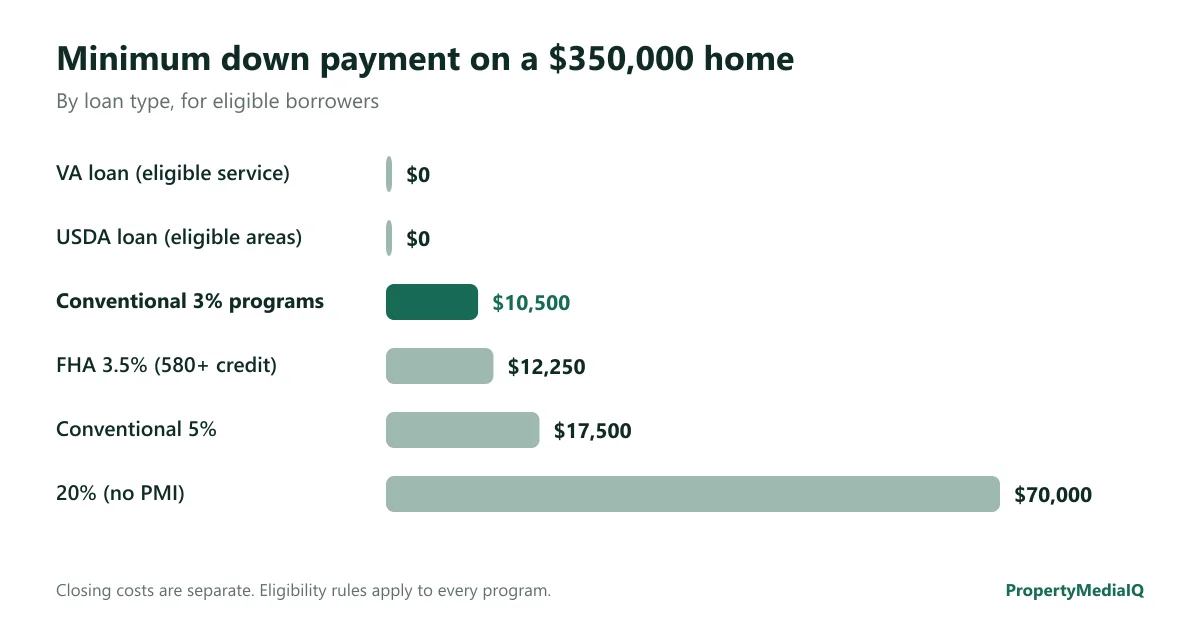
| Loan type | Minimum down payment | Key eligibility | Mortgage insurance |
|---|---|---|---|
| Conventional (e.g. 3% programs) | 3% for eligible buyers, often first-time buyers or income-limited programs | Credit, DTI and program rules | PMI until you reach enough equity; can be removed |
| FHA | 3.5% with a 580+ credit score (10% with 500–579) | Primary residence, FHA loan limits | Upfront and annual MIP; lasts the life of the loan with less than 10% down |
| VA | 0% | Eligible service members, veterans and some surviving spouses | No monthly mortgage insurance; a funding fee applies unless exempt |
| USDA | 0% | Eligible rural and suburban areas; household income limits | Upfront and annual guarantee fees |
| Conventional 20% | 20% | — | None |
Closing costs — lender fees, title, appraisal, prepaid taxes and insurance — are separate and often add a few percent of the price. Assistance programs frequently help with these too.
The trade-off of a smaller down payment
Putting less down gets you into a home sooner, but:
- the loan is larger, so the monthly payment is higher;
- mortgage insurance adds to the payment;
- you start with less equity, which matters if prices dip or you need to sell early.
For many buyers, that trade-off is worth it — especially when rent is similar to the ownership cost. Run the full numbers in how much house can I afford.
What is down payment assistance (DPA)?
Down payment assistance is money from a state housing finance agency, city, county, nonprofit or employer that helps cover a down payment and/or closing costs. It comes in four main forms:
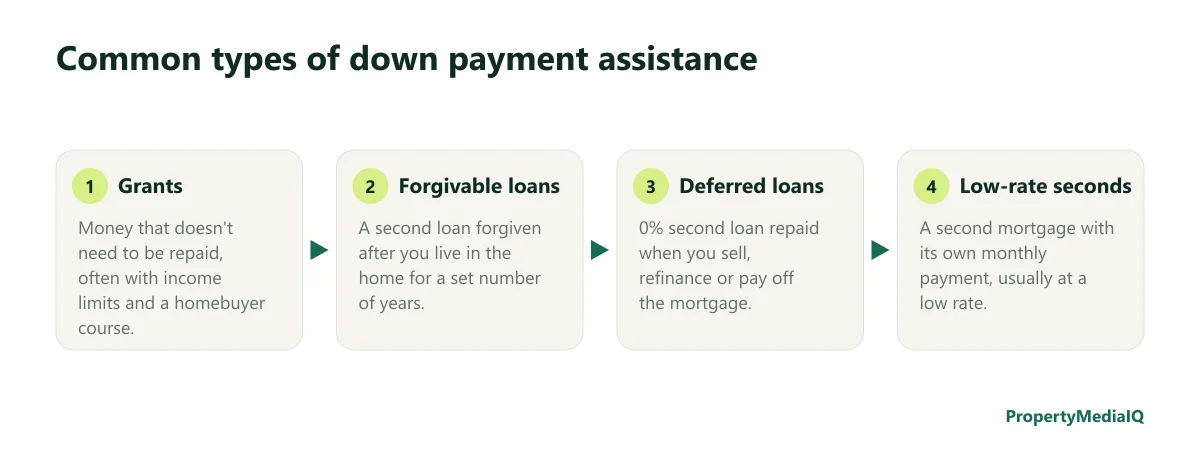
- Grants — gifts that don't need to be repaid, typically with income limits and a homebuyer education requirement.
- Forgivable loans — a second loan that's forgiven gradually if you live in the home for a set number of years.
- Deferred-payment loans — a 0% second loan with no monthly payment, repaid when you sell, refinance or pay off the mortgage.
- Low-interest second mortgages — a second loan with its own (usually small) monthly payment.
Some programs also offer mortgage credit certificates (a federal tax credit for part of the mortgage interest paid) or below-market first-mortgage rates.
Who qualifies?
Eligibility differs by program, but common requirements include:
- First-time buyer status — often defined as not having owned a home in the past three years, so previous owners can qualify again;
- Income limits — frequently tied to area median income;
- Purchase price limits;
- Primary residence — no investment properties;
- Homebuyer education — a short course, often online;
- Minimum credit score and maximum DTI set by the program or first-mortgage lender;
- A minimum personal contribution in some programs.
Many programs also target specific groups such as teachers, first responders, health care workers, veterans, or buyers in certain neighborhoods.
How to find programs near you
- Your state housing finance agency (HFA) — nearly every state has one, and it's usually the largest source of assistance.
- City and county housing departments.
- HUD-approved housing counseling agencies, which can explain local programs and often provide the required education course.
- Lenders who participate in local programs — not every lender does; ask directly.
- Your employer — some offer housing benefits.
Important things to check before you commit
- Is it a grant or a loan? And if a loan, when is it repaid?
- Recapture or resale rules — some programs require repayment if you sell within a certain period.
- Effect on your rate — some programs pair assistance with a slightly higher first-mortgage rate. Compare total cost.
- Timing — funds can run out; approval can add time to closing.
- Property requirements — condition, type and location rules.
Other ways to cover the down payment
- Gift funds from family, documented with a gift letter.
- Seller concessions toward closing costs (subject to loan-program limits).
- Retirement account options — some plans allow loans or withdrawals for a first home; understand taxes and penalties first.
- Lender credits in exchange for a slightly higher rate.
For real estate agents: helping first-time buyers see the path
Many first-time buyers rule themselves out because they think they need 20%. A short, respectful conversation about options — and a referral to a lender who knows local programs — can move a buyer from "someday" to "this year."
Practical steps:
- ask about financing status early and without judgment;
- keep a list of lenders who participate in your state HFA and local programs;
- expect longer timelines when DPA is involved and plan offers accordingly;
- help buyers see value in homes that need cosmetic updates — a virtual renovation concept can make a lower-priced home feel possible.
See our guide to working with first-time buyers. A short branded questionnaire before the first call — timeline, financing stage, budget range — tells you who needs education and a lender introduction, and who is ready to tour. That's what Buyer Intelligence does, with a readiness score and a call brief for every lead.
Frequently asked questions
Can I get down payment assistance if I've owned a home before? Often yes, if you haven't owned in the past three years, or if the program doesn't require first-time status.
Does down payment assistance have to be repaid? Grants don't; forgivable loans may not if you meet the occupancy term; deferred and second loans do.
Can I combine assistance with an FHA or conventional loan? Usually yes — most programs pair with FHA, conventional, and sometimes VA or USDA loans.
Is 3% down really possible? Yes, for eligible buyers under certain conventional programs, and 3.5% with FHA.
The bottom line
Twenty percent down is a choice, not a requirement. Compare low-down-payment loans, check your state and local assistance programs, understand the repayment terms, and work with a lender who knows the programs in your area.
Agents: identify first-time buyers who need a lender introduction →
Know which buyers are ready before you call.
Share one branded link and get a readiness score, report, and call brief for every lead — from $39/month.