Pre-Qualification vs. Pre-Approval: What's the Difference (and Which Do You Need)?
Updated September 27, 2026 · 5 min read
The two terms sound almost identical, and some lenders use them loosely. But in practice they mean very different things — and the difference decides how seriously a seller takes your offer.
Short version: a pre-qualification is an estimate of what you might borrow based on information you provide. A pre-approval is a lender's conditional commitment based on information they have verified. When you're ready to make offers, you want a pre-approval.
Educational content, not lending advice. Terms and processes vary by lender.
Side-by-side comparison
| Pre-qualification | Pre-approval | |
|---|---|---|
| What it is | An estimate | A conditional commitment in principle |
| Based on | Information you report | Information the lender verifies |
| Credit check | Often soft (no score impact) or none | Usually a hard inquiry |
| Documents | Few or none | Pay stubs, W-2s or tax returns, bank statements, ID |
| Time | Minutes | Usually one to a few days |
| Result | A rough price range | A letter with a specific amount and loan type |
| Seller's view | Weak signal | Strong signal |
| Best for | Early planning | Shopping and making offers |
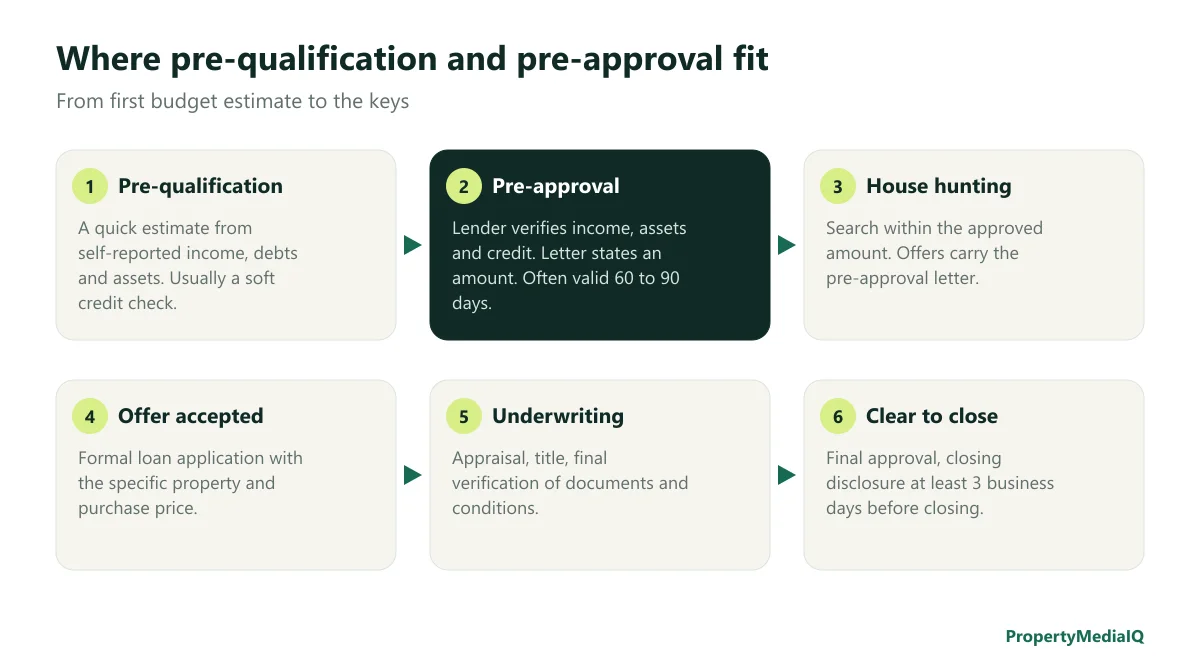
What pre-qualification involves
You share basic information — income, debts, assets, an idea of your credit — and the lender or an online tool estimates what you might be able to borrow. It's useful for:
- getting a first price range before you start browsing seriously;
- seeing roughly how rates and down payment affect that range;
- deciding whether to spend a few months improving credit or paying down debt first.
Its weakness is that nothing is verified. If income is overstated or a debt is forgotten, the number is wrong — and you won't find out until later.
What pre-approval involves
The lender reviews your actual documents and credit report and issues a letter stating how much you're approved to borrow, for which loan type, subject to conditions.
Typical documents:
- Income: recent pay stubs and W-2s; two years of tax returns if self-employed; documentation of bonuses, commissions or other income.
- Assets: recent bank and investment statements, and a gift letter if family is contributing to the down payment.
- Debts: the lender sees most on your credit report; be ready to explain anything unusual.
- Identity and authorization for a credit check.
The lender uses this to calculate your debt-to-income ratio and confirm you meet the program's requirements.
What pre-approval is not
A pre-approval is not a final loan approval. After an offer is accepted, the lender still needs to:
- appraise the property;
- review title;
- re-verify income, employment and assets;
- clear any conditions listed on your approval.
Things that can derail a loan between pre-approval and closing: a job change, new debt (a car, furniture on credit), large unexplained deposits, or missed payments. The safest rule: no new credit and no big financial changes until you close.
How long does a pre-approval last?
Pre-approval letters are commonly valid for around 60 to 90 days, because credit and financial documents go stale. If your search takes longer, the lender will update documents and may pull credit again.
Does pre-approval hurt your credit score?
A hard inquiry can cause a small, temporary dip. Credit scoring models generally treat multiple mortgage inquiries within a short shopping window as a single inquiry, so comparing several lenders within a few weeks usually has little extra effect. That's worth doing — rates and fees differ between lenders.
Why sellers care
When a seller compares offers, the question is not only "how much?" but "how likely is this to close?" A pre-approval letter shows a lender has already reviewed the buyer's finances. In competitive situations, offers without one are often set aside. Some buyers go further with a fully underwritten pre-approval, where the lender completes more of the review before an offer — ask your lender whether they offer it.
Which do you need, and when?
| Your situation | What to get |
|---|---|
| Curious, 6+ months from buying | Pre-qualification or an online estimate |
| Planning to buy in the next few months | Pre-approval before touring seriously |
| Ready to make offers now | Current pre-approval (updated within its validity window) |
| Paying cash | Proof of funds instead |
A checklist for getting pre-approved
- Check your credit reports and fix errors.
- Gather 30 days of pay stubs, two years of W-2s (or tax returns), and two months of bank statements.
- Decide on a comfortable monthly payment — see how much house you can afford.
- Compare at least two or three lenders on rate, fees and responsiveness.
- Ask what loan types you qualify for: conventional, FHA, VA, USDA, and any down payment assistance.
- Keep finances stable until closing.
For real estate agents: why financing status is your best qualifying signal
Of everything you can learn before a first call, financing status is usually the most predictive of how soon a buyer can act. It also tells you what help they need:
| Financing status | What the buyer needs from you |
|---|---|
| Pre-approved | Matched listings and a showing plan |
| Talking to a lender | Help understanding their budget in real homes; a lender check-in |
| Not started | A warm introduction to a lender and an explanation of the process |
| Cash | Proof of funds and speed |
Ask about it early, in writing, without asking for documents or sensitive numbers — the lender handles those. The Buyer Intelligence assessment asks "Where are you with financing?" (pre-approved, speaking with a lender, cash purchase, or not started) alongside timeline and budget range, and turns the answers into a readiness score and call brief. More on building this into your process in how to qualify buyer leads before the first call.
Frequently asked questions
Can I be denied after pre-approval? Yes, if your finances change, information can't be verified, the appraisal comes in low, or the property doesn't meet program requirements.
Is pre-approval free? Many lenders don't charge for it; ask upfront.
Can I get pre-approved with more than one lender? Yes, and comparing offers is sensible. Keep applications within a short window.
Does a pre-approval lock my rate? No. A rate lock is separate and usually happens after an offer is accepted.
The bottom line
Use pre-qualification to plan; get pre-approved before you shop seriously; keep your finances steady until closing. And if you're an agent, make financing status the first thing you learn about every buyer lead.
See how Buyer Intelligence qualifies buyers before the first call →
Know which buyers are ready before you call.
Share one branded link and get a readiness score, report, and call brief for every lead — from $39/month.