How Mortgage Rates Affect Buying Power: Tables for Buyers and Agents
Updated September 27, 2026 · 5 min read
Mortgage rates are the one part of home affordability buyers can't control — and they move the numbers more than most people expect. A single percentage point can change what a household can afford by tens of thousands of dollars. This guide shows exactly how much, with tables you can use, and what buyers can do about it.
All figures are principal and interest on a 30-year fixed mortgage unless stated. Educational, not financial advice.
Rule of thumb
At typical loan sizes, each 1% increase in rate reduces buying power by roughly 10% at the same monthly payment. Each half-point is roughly 5%.
Monthly payment on a $400,000 loan
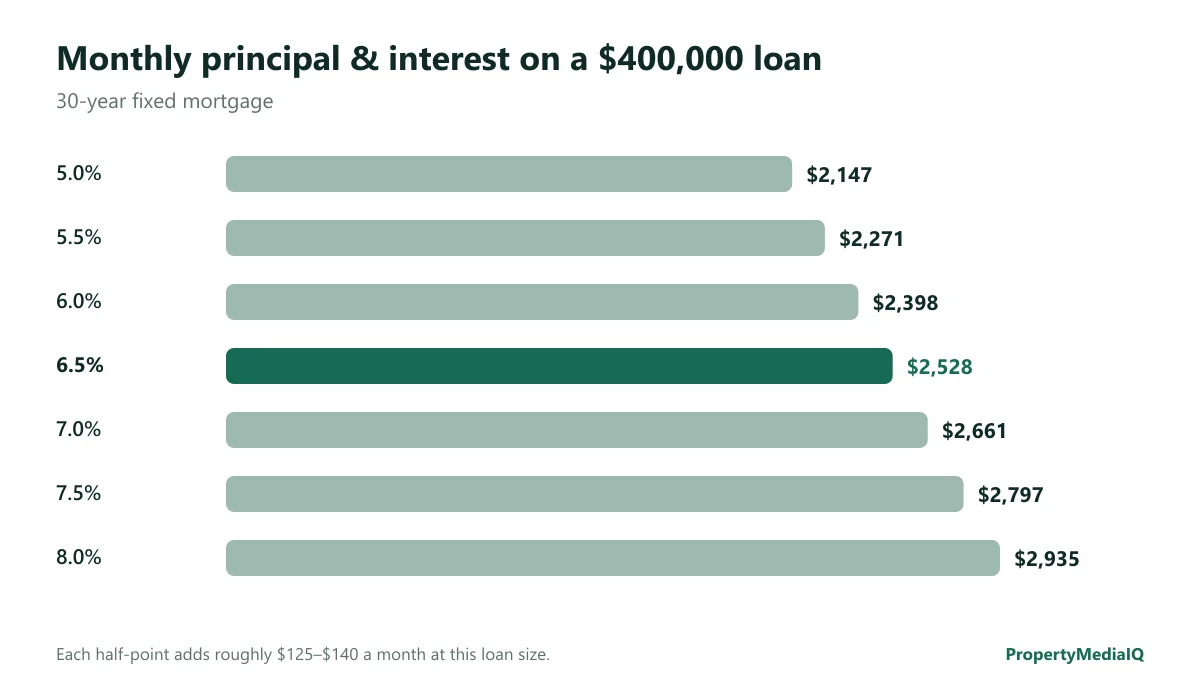
| Rate | Monthly P&I | Difference vs. 6.5% | Total interest over 30 years |
|---|---|---|---|
| 5.0% | $2,147 | −$381 | ~$373,000 |
| 5.5% | $2,271 | −$257 | ~$418,000 |
| 6.0% | $2,398 | −$130 | ~$463,000 |
| 6.5% | $2,528 | — | ~$510,000 |
| 7.0% | $2,661 | +$133 | ~$558,000 |
| 7.5% | $2,797 | +$269 | ~$607,000 |
| 8.0% | $2,935 | +$407 | ~$657,000 |
How much loan a fixed budget supports
Most buyers think in monthly payments, not loan amounts. Here's what a $2,500 monthly principal & interest budget supports at different rates:
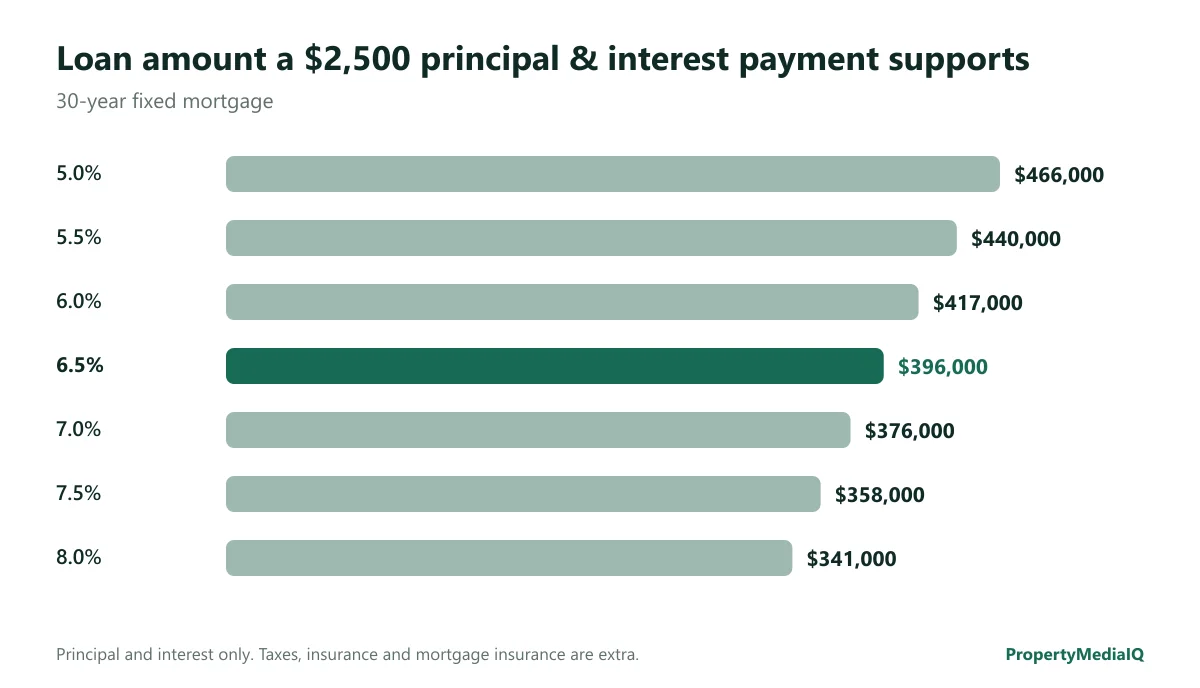
| Rate | Loan amount for $2,500 P&I |
|---|---|
| 5.0% | ~$466,000 |
| 5.5% | ~$440,000 |
| 6.0% | ~$417,000 |
| 6.5% | ~$396,000 |
| 7.0% | ~$376,000 |
| 7.5% | ~$358,000 |
| 8.0% | ~$341,000 |
Add taxes, insurance, mortgage insurance and HOA dues to get the full payment — see how much house can I afford for a complete breakdown.
What moves mortgage rates?
Mortgage rates are set by lenders but follow broader markets, especially longer-term bond yields and expectations about inflation and central bank policy. Your personal rate then depends on:
- credit score — often the biggest personal factor;
- down payment / loan-to-value — more equity usually means a better price;
- loan type — conventional, FHA, VA, USDA and jumbo are priced differently;
- loan term — 15-year loans usually carry lower rates than 30-year;
- points — paying upfront to lower the rate;
- lock period — longer locks can cost more.
Rate buydowns
A buydown lowers your rate in exchange for an upfront payment — by you, the seller, or sometimes the builder.
| Type | How it works | Best when |
|---|---|---|
| Permanent buydown (points) | Pay points at closing to lower the rate for the life of the loan | You'll keep the loan long enough to pass the break-even point |
| Temporary buydown (e.g. 2-1) | Rate is lower for the first one or two years, then returns to the note rate | You expect income to rise or plan to refinance, and a seller will fund it |
| Seller concessions | Seller credits cover points or closing costs | Buyer's market or homes with longer days on market |
To evaluate points, divide the cost by the monthly savings to find the break-even month. If you'll likely sell or refinance before then, points don't pay.
Strategies when rates are high
- Negotiate seller credits for a buydown instead of a price cut — the monthly impact can be larger.
- Consider adjustable-rate or hybrid loans only if you understand the adjustment caps and your plans.
- Look at assumable loans — some FHA and VA loans can be assumed by a qualified buyer at the existing rate.
- Improve your credit score before locking.
- Compare lenders — pricing differs.
- Buy the right home, not the rate. "Marry the house, date the rate" assumes refinancing will be possible later — plan so the payment works even if it isn't.
Strategies when rates fall
- Get re-pre-approved — your approval amount may rise.
- Expect more competition as other buyers return; have financing ready.
- Don't wait for the bottom. Rates are hard to time, and prices can rise as demand returns.
For real estate agents: talking rates with buyers
Rate changes quickly shift which listings fit a buyer. A few practices keep clients on track:
- Anchor on payment, not price. Ask buyers what monthly payment feels comfortable and translate it into a price range using current rates.
- Revisit readiness when rates move. A buyer who was "early" at 7.5% may be ready at 6.5%. Re-send your buyer questionnaire when conditions change.
- Use seller credits creatively on listings with longer days on market.
- Keep listings attractive to payment-sensitive buyers. Staged photos and video help price-appropriate homes stand out — see Property Media.
Knowing which of your leads are pre-approved and what range they're shopping in lets you reach the right buyers first when rates move. Buyer Intelligence captures timeline, financing status and budget range for every lead and sorts them by readiness. Related: convert online buyer leads into consultations.
Frequently asked questions
How much does a 1% rate increase cost per month? On a $400,000 loan, going from 6.5% to 7.5% adds about $269 a month in principal and interest.
Is it better to buy points or put more down? It depends on how long you'll keep the loan and whether more down would remove mortgage insurance. Compare break-even periods.
Can I lock a rate before I find a home? Some lenders offer lock-and-shop programs; most locks happen after an offer is accepted.
The bottom line
Rates change buying power by roughly 10% per point. Plan around a comfortable payment, know your break-even on points, and keep your pre-approval current so you can act when the numbers work.
Know which buyers are ready before you call.
Share one branded link and get a readiness score, report, and call brief for every lead — from $39/month.